AI is quickly becoming one of the biggest talking points in construction technology. Software companies are promising AI-powered estimating, automated bidding, and smarter project forecasting tools designed to help contractors bid faster and improve accuracy.
For heavy civil contractors, the conversation around AI often raises an important question:
Is AI actually helping estimators — or is it just another industry buzzword?
Heavy civil estimating is too complex to rely entirely on automation. Estimators still need field knowledge, production understanding, subcontractor relationships, and experience interpreting changing job conditions. No AI tool can fully replace that.
At the same time, there’s no denying that technology is changing the estimating process. Contractors are under pressure to bid faster, improve accuracy, reduce missed items, and stay competitive in a market with tighter margins and increasing project complexity.
The future of AI in heavy civil estimating will likely not be about replacing estimators. Instead, it will help contractors reduce repetitive work, organize data more effectively, and make better informed decisions throughout the bidding process.
According to the McKinsey construction AI report, construction remains one of the least digitized industries, but advancements in automation and data-driven workflows are creating major opportunities to improve productivity and reduce inefficiencies across construction operations.
Why Construction Has Been Slow to Adopt AI
Compared to industries like finance or manufacturing, construction has historically been slower to adopt advanced technology — especially artificial intelligence. Recent AGC and Sage research shows that many contractors are still focused on improving workforce efficiency, standardizing workflows, and managing labor shortages before fully embracing emerging AI technologies.
One reason is that construction projects are rarely predictable. Weather delays, changing site conditions, fluctuating material pricing, subcontractor availability, and DOT estimating requirements all introduce variables that are difficult for AI systems to fully understand.
Another challenge is data consistency. Many contractors still rely heavily on spreadsheets, disconnected files, handwritten notes, or estimating processes built around tribal knowledge from experienced employees. Without organized historical data, AI tools have a limited ability to provide meaningful insights.
There’s also a trust factor. Heavy civil contractors are responsible for managing millions of dollars in risk on every project. Most estimators are understandably cautious about relying on technology that may not fully understand the realities of the field.
This skepticism is not necessarily a bad thing. In fact, many contractors are taking a practical approach by focusing first on improving estimating workflows, organizing historical bid data, and reducing manual processes before jumping into experimental AI solutions.
How AI Is Improving Heavy Civil Estimating
Despite the hype surrounding AI, industry research shows contractors increasingly believe AI and construction estimating automation will improve productivity, estimating workflows, and project decision-making in the years ahead. New research by the Dodge Construction Network and CMiC examine how AI is reshaping the industry.
Historical Cost Analysis
One of the biggest advantages of technology in estimating is the ability to organize and reference historical bid data more efficiently. Estimators can use previous project information to compare production rates, material pricing, subcontractor costs, and labor assumptions when building new estimates.
This helps estimators make faster, more informed decisions without rebuilding every estimate from scratch.
Faster Quantity Review
AI-assisted workflows and automation tools may help estimators review quantities, identify inconsistencies, and reduce manual data entry. While these systems still require human oversight, they can help contractors speed up repetitive estimating tasks.
For example, estimators working on excavation projects may use automated workflows to review earthwork quantities, compare subcontractor pricing, or identify missing bid items across multiple DOT bid packages.
Bid Risk Identification
Advanced estimating workflows can also help contractors identify unusual pricing patterns, production inconsistencies, or missing scope items before bids are submitted.
For example, a AI tools could scan a project bid and find that no mobilization costs were added to the total bid, alerting the estimator to potential high dollar mistakes that would eat into profit if awarded the project.
Proposal and Documentation Support
Technology is also improving how contractors manage bid documentation, clarifications, and estimate organization. Automating repetitive administrative tasks allows estimators to spend more time analyzing jobs and less time handling paperwork.
Data Organization and Accessibility
For many contractors, one of the most valuable improvements is simply having organized access to their estimates, production data, and bid information. Better visibility into past projects allows estimators to work more consistently and efficiently over time.
What AI Still Can’t Replace
While AI construction estimating tools can improve efficiency, experienced estimators still play a critical role in managing project risk, interpreting plans and specifications, and understanding real-world project conditions.
They understand:
- Project Scope and Risks
- Contractual Requirements
- Crew Production Capabilities
- Subcontractor Relationships
- Equipment Limitations
- Site Logistics
- DOT Specifications
- Weather Challenges
AI may help support decision-making, but it cannot replace field experience or contractor judgment. An estimator who understands how work actually gets done will always outperform AI's assumed calculations. That’s especially true in heavy civil construction, where every project comes with unique conditions that require practical knowledge and critical thinking.
The Biggest Risk of AI in Estimating
While AI offers potential benefits, contractors should also understand the risks that come when relying too heavily on construction estimating automation. AI systems are only as reliable as the data they receive. Inaccurate historical data, incomplete estimates, or inconsistent workflows can lead to poor recommendations and unreliable outputs.
There’s also the risk of over-automation. Estimators who blindly trust automated suggestions without reviewing assumptions may overlook major project risks, quantity issues, or specification requirements. In construction, mistakes made during estimating can have significant financial consequences. That’s why technology should support estimator expertise — not replace it.
Contractors should be cautious of software platforms that market fully automated estimating tools without emphasizing the importance of estimator oversight and validation.
The Future of AI and Heavy Civil Construction Estimating Automation
The future of AI in heavy civil estimating will likely focus less on replacing estimators and more on improving workflow efficiency, estimate organization, and data accessibility.
Contractors who already have strong estimating systems, organized historical data, and consistent workflows will likely be in the best position to benefit from future advancements in construction technology.
For most heavy civil contractors, the real opportunity isn’t fully automated estimating. It’s using technology to:
- Reduce repetitive work
- Improve accuracy
- Organize historical data
- Simplify estimate setup
- Improve visibility across projects
- Help estimators make faster, more informed decisions
TCLI's Approach to AI and Construction Estimating Automation
As AI continues gaining attention in construction, many contractors are wondering how it fits into the estimating process. At TCLI, the focus has always been on helping estimators work faster, more accurately, and with greater consistency — without replacing the experience and judgment that heavy civil estimating depends on.
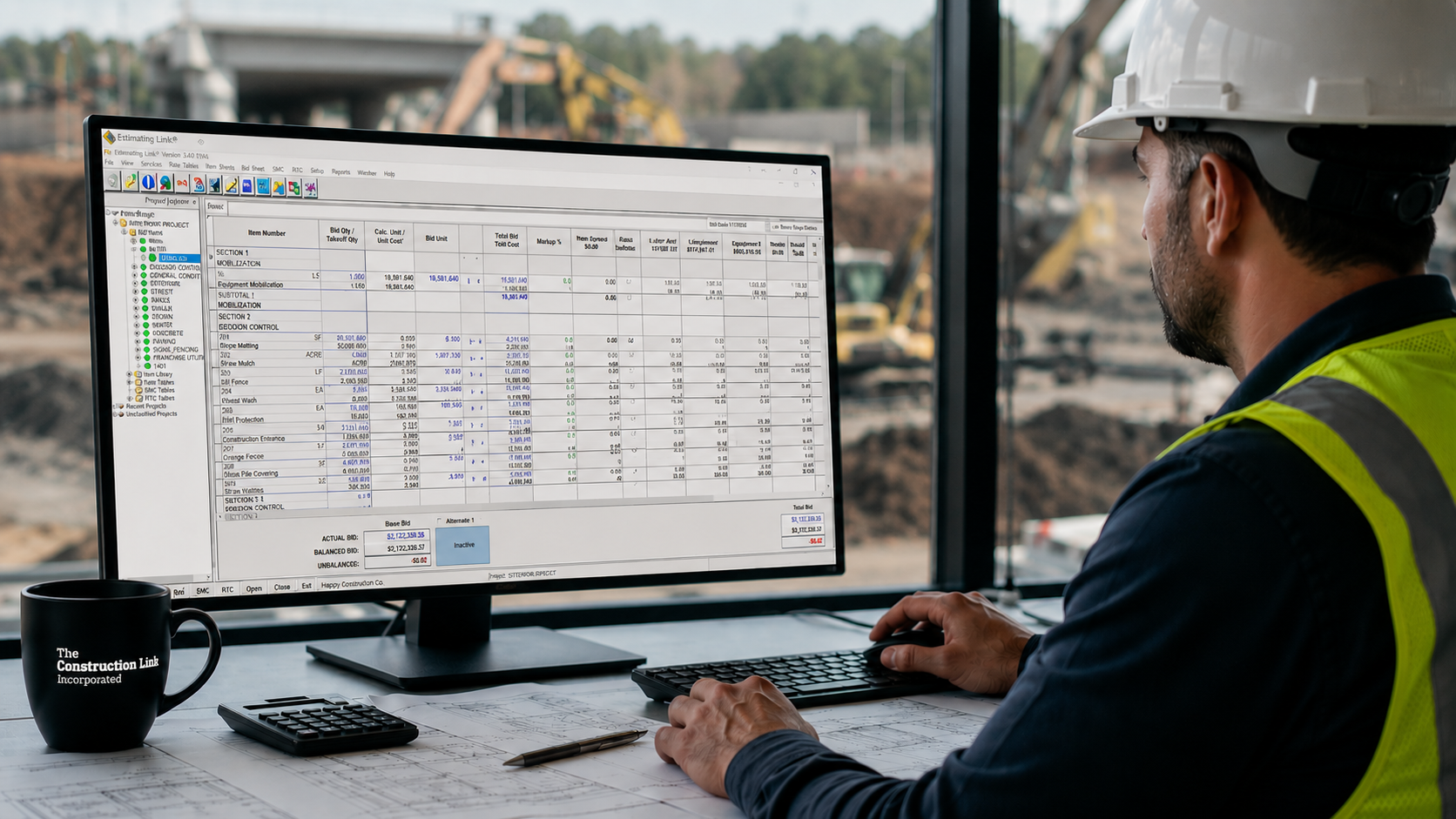
While Estimating Link® is not currently built around artificial intelligence, many of the workflow improvements contractors are looking for from AI already exist through practical estimating automation tools built into the software.
Features like Build Wizard help simplify estimate setup and reduce repetitive data entry. Historical estimate workflows make it easier to reuse previous bids instead of starting from scratch. Built-in estimate review tools and safeguards help contractors catch potential oversights before submitting bids.
How Estimating Link® Helps Heavy Civil Contractors Improve Estimating Workflows
Heavy civil contractors don’t need AI to replace estimators. They need estimating software that helps teams work faster, stay organized, and improve consistency across bids. Estimating Link® helps contractors simplify estimating workflows, manage historical bid data, and improve estimate accuracy without sacrificing estimator control.
If you want to see how Estimating Link® help you simplify estimating workflows, organize historical bid data, and improve estimating consistency, schedule a demo with our team today.