
A construction estimating database helps contractors turn historical cost data into better estimating decisions. Learn how tracking actual job costs, production rates, and historical bid information can improve future construction estimates.
Every contractor has valuable estimating information somewhere. It may be buried in old bid files, spreadsheets, project folders, or even stored in the memory of your longtime estimator.
Historical cost data gives estimators a way to learn from previous projects and make more informed decisions on future bids. By organizing labor costs, equipment costs, material pricing, production rates, and actual job costs into a construction estimating database, contractors can improve estimating accuracy, reduce guesswork, and build more consistent bids.
What Is a Construction Estimating Database?
A construction estimating database is a collection of historical cost information used to support future estimates. It typically includes labor costs, equipment costs, material pricing, subcontractor pricing, production rates, and historical bid data from your completed projects.
Think of it as a centralized source of all of your estimating knowledge. Rather than relying on memory or searching through old files, estimators can reference previous project information to validate assumptions, compare costs, and improve future bids. Over time, a well-maintained construction estimating database becomes one of the most valuable tools an estimator can use.
Why Historical Cost Data Matters
Estimators make decisions about labor productivity, equipment usage, production rates, material pricing, and subcontractor costs before work ever begins. The more accurate those assumptions are, the more reliable the estimate becomes.
Instead of relying solely on industry averages or best guesses, contractors can use information from completed projects to understand how work was actually performed.
According to guidance from the Federal Highway Administration (FHWA), historical project information and documented estimating assumptions are important components of developing reliable construction cost estimates. By reviewing previous project performance, contractors can improve consistency and make more informed estimating decisions.
Historical cost data helps estimators answer questions such as:
-
How many labor hours did similar work require?
-
What production rates were achieved in the field?
-
How much equipment time was needed?
-
Were there costs that were missed during the original estimate?
-
How did actual costs compare to the bid?
The answers to these questions can significantly improve future estimates.
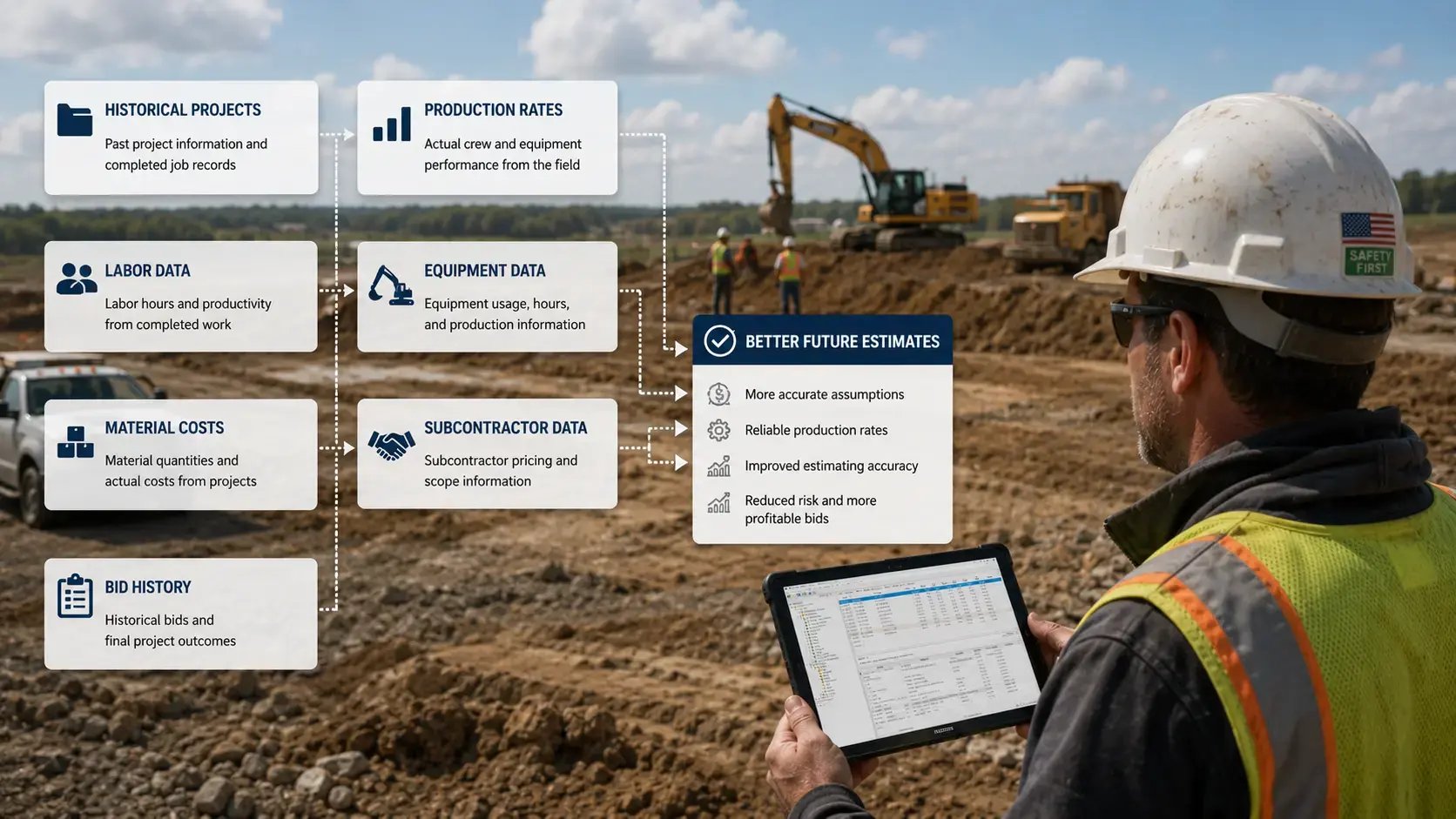
How Historical Cost Data Improves Estimating Accuracy
One of the biggest benefits of maintaining a construction estimating database is improved estimating accuracy.
Better Unit Pricing
Unit prices should reflect real-world project experience whenever possible. Historical job data helps contractors verify whether unit prices are realistic based on actual costs from completed work. This allows estimators to identify pricing that may no longer be accurate due to changing labor, material, or equipment costs.
More Reliable Production Rates
Production rates are a critical component of heavy civil construction estimating. By reviewing historical production rates from previous projects, estimators can better understand how crews and equipment perform under real jobsite conditions.
If you're interested in learning more about production rates and their role in estimating, read our guide on What Are Production Rates in Construction Estimating? Historical production data often provides a more realistic foundation than assumptions alone.
Improved Labor Assumptions
Labor costs are frequently some of the largest expenses in a construction project. Reviewing actual labor hours from completed projects allows estimators to compare planned labor requirements against real-world results. This can help identify opportunities to improve future estimates and avoid underestimating labor needs.
For a deeper look at labor calculations, check out our guide on How to Calculate Labor Cost for a Construction Bid.
Greater Consistency Across Estimates
Without historical cost data, different estimators may approach the same project differently. A construction estimating database provides a shared source of information that can improve consistency across estimating teams and reduce variations caused by individual assumptions.
Why Memory and Spreadsheets Eventually Become a Problem
Many contractors start by tracking historical cost information in spreadsheets or personal files. While that may work initially, problems often arise as the business grows, projects become larger and more complex, or experienced employees leave the company.
Common challenges include:
-
Historical estimates stored in multiple locations
-
Inconsistent naming conventions and cost categories
-
Difficulty finding previous project information
-
Estimating knowledge concentrated in one person's memory
-
Limited visibility into actual project performance
When valuable information exists only in spreadsheets or individual experience, contractors risk losing years of estimating knowledge. A construction estimating database helps preserve that information and make it available to the entire team.
What Data Should Contractors Track for Future Estimates?
Building an effective construction estimating database starts with collecting the right information.
Contractors should consider tracking:
-
Labor costs
-
Equipment costs
-
Material pricing
-
Production rates
-
Subcontractor costs
-
Historical bid results
-
Cost codes
The more organized and consistent the information is, the more valuable it becomes over time. Even small improvements in data collection can provide significant estimating benefits in the future.
Building a Construction Estimating Database
Creating a construction estimating database does not have to be complicated.
A good starting point is to:
- Save completed estimates.
- Track actual job costs.
- Document production rates and labor productivity.
- Review project outcomes after completion.
- Standardize cost categories and cost codes.
- Update historical information regularly.
Over time, these records become a valuable resource that helps improve estimating accuracy and supports better bidding decisions. The goal is not simply to store information—it's to make that information useful for future estimates.
Build a Construction Estimating Database That Works for You
Historical cost data is one of the most valuable resources a contractor can use to improve future estimates. By building and maintaining a construction estimating database, contractors can make more informed decisions, improve estimate accuracy, reduce uncertainty, and create more consistent bids based on real project performance.
The best estimates aren't built on guesswork—they're built on experience and accurate data. If you're looking for a better way to organize historical cost data, production rates, and estimating information, schedule a demo to see how Estimating Link helps contractors build more accurate and consistent estimates.