By Kathleen Ward Vacanti, Chief Executive Officer, The Construction Link, Inc.
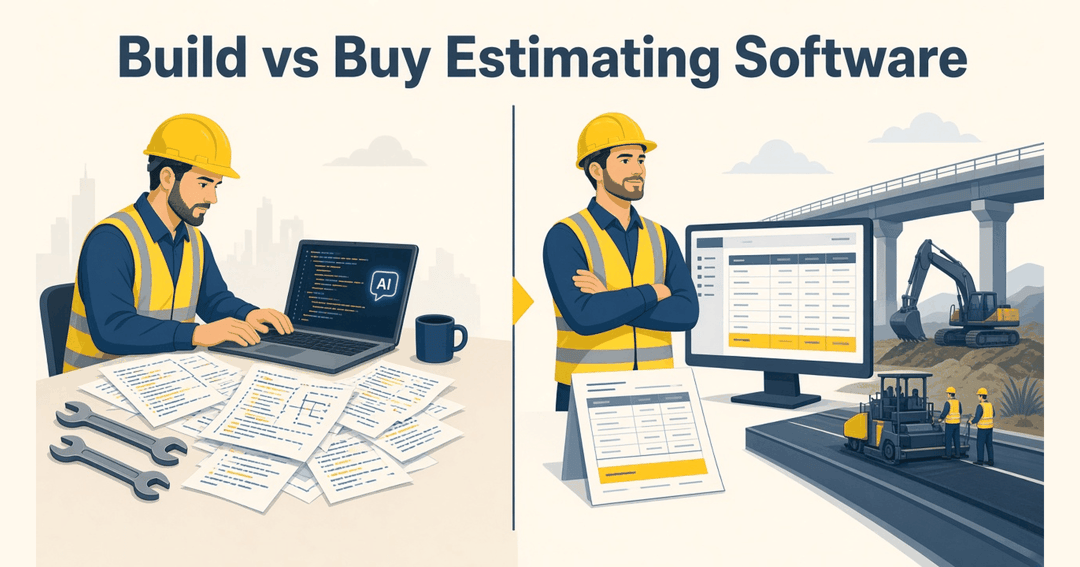
Lately, my team keeps hearing from heavy civil contractors who are building their own estimating software. Most of them are using, or planning to use, AI coding tools to do it. Here’s how I’d think about build vs buy for construction estimating software.
The appeal is easy to see: pay someone once for a program built exactly around how you bid, and never pay a subscription again. You know how you build crews and how you want your reports to look, and AI makes it easier than ever to turn an idea into code. Honestly, I get it.
My dad, Lance R. Ward, built the first version of Estimating Link® for that exact reason: he was a contractor who needed a better way to bid his own work. If he hadn’t taken that risk 40 years ago, who knows what I’d be doing, but I bet it would involve a lot more spreadsheets. I’m thankful every day that he did. TCLI has been building and supporting Estimating Link ever since 1986. I sell estimating software, so you can probably guess where I land. But this post isn’t about talking anyone out of a good idea. It’s an honest look at what building your own estimating software really takes, so you can make the call with your eyes open.
To be clear, my team and I aren’t against AI. We’re constantly trying new platforms and tools, and we’re excited about what this wave of innovation makes possible. I’ll be the first to admit that AI helped me write this article, and right now I have a whole team of AI agents working on other things in the background. What we believe is that AI has to be used responsibly. It doesn’t replace real expertise, years of hands-on experience, or decades of customer feedback built into how the software works.
Should I Build My Own Estimating Software with AI?
For most heavy civil contractors, building the first version isn’t the hard part. Keeping it accurate, secure, supported, and up to date for years, while you’re also running a construction company, is.
Writing the code is just one step. You also have to design it, test it, host it, secure it, patch it, monitor it, and fix it when it breaks, and most of that never really ends. If your business is building roads, utilities, and site work, your software becomes a second business. Ask yourself who will own it five years from now. Who fixes it the night before a bid? Who updates it when your process changes? If you have clear answers to those questions, building may make sense for you. If you don’t, buying is usually the safer bet, in money and in risk. Gartner’s build vs buy guidance draws a similar line: custom development makes sense for capabilities that offer “competitive differentiation,” and otherwise the rule is to “build only what you must.”
Can AI Coding Tools Build Construction Estimating Software?
Yes, AI coding tools can help someone build a working estimating tool, and they’re getting better fast. What today’s tools can’t do on their own is decide how your estimate should work, test it against every way your estimators bid, or stand behind the numbers when something goes wrong.
An estimating system for heavy civil work isn’t a simple calculator. It has to handle unit price and lump sum bids, crews, production rates, equipment, materials, subcontractor and vendor quotes, indirects, markups, alternates, and reports your owners and agencies expect. (We go deeper on that in why heavy civil contractors need specialized estimating software.)
AI can write code quickly. In our experience, you still need someone who knows what “right” looks like for every piece and can catch it when the code is wrong. Developers know this well. In the 2025 Stack Overflow Developer Survey, the biggest single frustration with AI tools, cited by 66% of developers, was “AI solutions that are almost right, but not quite.” In estimating, almost right is a problem.
Our development team has found that today’s AI tools are good at writing pieces of a program, but they still struggle with architecture, meaning how the whole system fits together. They also tend to write more code than the job needs. A job that needs about 1,000 lines can come back as 4,000, and we see that often. Then the next developer can spend hours digging to find and fix things. GitClear’s 2026 research points the same way: as AI-assisted coding grew, duplicated blocks of code rose 81% from 2023 to so far in 2026. More duplicated code means more to maintain.
Worse, when the data underneath is wrong, we’ve also seen AI tools work around the problem instead of fixing it, so the screen still looks right. In an estimate, that means numbers that look fine but were calculated wrong, and you may not find out until bid day or after award.
It also takes longer than it looks. You usually don’t know exactly what you need until you’re halfway there, and changing direction mid-build is where AI-built code gets tangled. We’ve spent more than five years getting the core of Estimating Link 4 right, and so far we haven’t found a tool that can shortcut that work.
Sticking with it is harder than starting, too. Ryan, our Front-End Developer, has spent the last few years building the front end of Estimating Link 4 (EL4), the web version of Estimating Link. He’s seen plenty of non-technical people try vibe-coding their own apps (building them by prompting an AI tool), and he’s yet to see one of them stick with it.
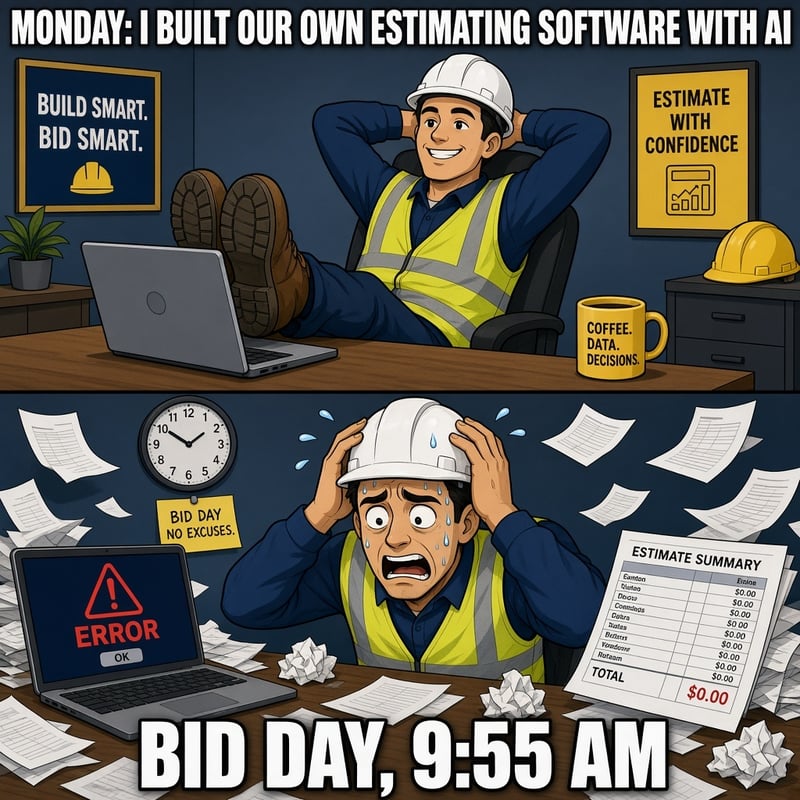
There’s a reason it’s so easy to get pulled in. In Breaking the Spell of Vibe Coding, Rachel Thomas, co-founder of fast.ai, compares vibe coding to a slot machine. The code keeps coming and the AI keeps offering you choices, so you feel in charge. It’s an illusion of control. It feels like progress, but often you don’t find out for weeks or months whether the code is any good. She borrows a gambling term for that: a “loss disguised as a win.” For an estimator, that’s a tool that looks finished on Monday and falls apart on bid day.
A 2025 METR study found something similar: experienced developers using early-2025 AI tools took 19% longer but believed they were 20% faster. Newer tools likely help more, but the lesson holds: how fast it feels isn’t always how fast it is.
So far, AI works best for us in the hands of people who already know what “right” looks like. If you’re curious where AI fits inside estimating, see the future of AI in heavy civil estimating.
How Much Does It Cost to Build Custom Estimating Software for a Heavy Civil Contractor?
More than the first version suggests, because most of the cost comes after launch. You’re paying for development, plus ongoing maintenance, hosting, security, backups, testing, training, and support for as long as you use it.
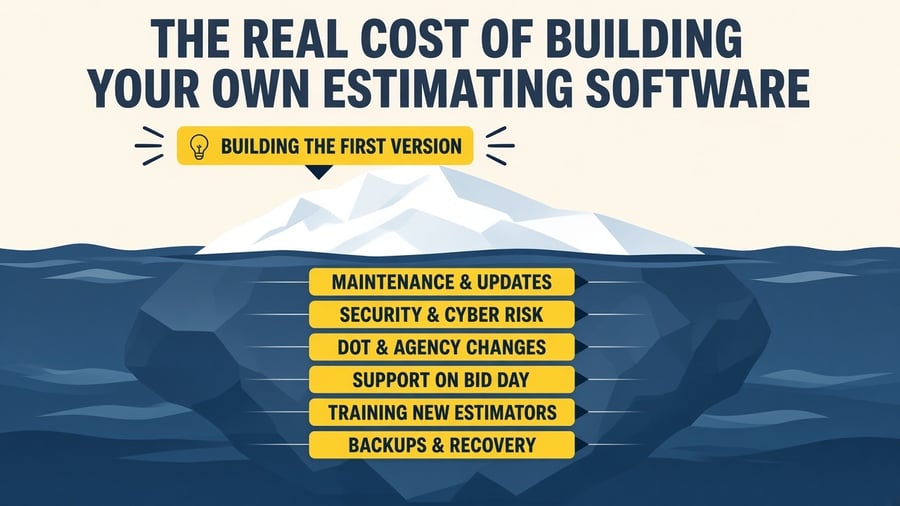
I won’t throw out a dollar figure, because every company is different. But research on software in general backs this up. As Robert Glass wrote in IEEE Software, “Maintenance typically consumes about 40 to 80 percent (60 percent average) of software costs.” Here’s what to put on your list before you compare:
- Your own people’s time. This is the one that’s easiest to miss. Someone, usually your best estimator, has to spend hours explaining workflows, testing, and fixing specs with the developer instead of bidding work. That cost never shows up on the developer’s invoice.
- Ongoing changes. Your rate tables, crews, markups, and proposal formats change from season to season. Every change is more development.
- Hosting, security, and backups. Your bid data is some of the most sensitive information your company has. Protecting it is an ongoing responsibility.
- Training and support. When you hire an estimator in the middle of bid season, someone has to teach them on a system only your company uses, and answer their questions.
- Testing. Every update has to be checked so a fix to one calculation doesn’t quietly change unit prices on bids you’ve already priced.
A one-time build can look cheaper than a subscription, and in year one it might be. The fair comparison is total cost over the years you’ll use it. With a custom build, every item on that list is a separate cost you carry yourself. With a subscription, updates and support are part of what you pay for. (At TCLI, support and continuing education are always included.) Neither is automatically cheaper. Run the numbers both ways for your own company.
For more on what goes into estimating software pricing, see how much estimating software costs.
What Are the Risks of In-House Estimating Software?
The biggest risks of in-house estimating software come after it’s built: maintenance never ends, knowledge often ends up in one person’s head, outside requirements change, data has to be protected, and something may break on bid day.
Chris Denker, our Chief Software Architect, has helped build Estimating Link since the company’s first days, and for more than 40 years he’s been one of our most critical people. He knows Estimating Link inside and out, and he’s an expert in programming, system architecture, and networking. He’s one of the smartest people I know, so when he raises a concern, I listen. He’s careful, too. He double-checks everything, and he makes a backup before he changes anything.
Chris isn’t against AI either, but his first question about any software is the same: “Can it be maintained by human beings and understood?” He’s seen AI-written code that works but doesn’t fit how the business actually thinks about the problem. Most contractors don’t have the time or people to write detailed specs up front, so when you go back to add a feature, you end up tracing through the code in circles. As Chris says, “I’ve been there.” The core of an estimating system is a foundation you’ll build on for years, so it has to be solid. For Chris, the real risk isn’t building it. It’s maintaining it.
Maintenance never stops. At TCLI, we release updates many times a year. Software also has to keep working when Microsoft updates Windows and when new PCs come out. Windows updates arrive every month, and any one of them can break something. In October 2026, Microsoft’s monthly security update fixed a record-breaking 1,411 flaws. That’s a lot of change landing under your software in a single month. With in-house software, all of that is on you.
The one developer who leaves. This is the one I’d worry about most. If the one person who really understands your system leaves, retires, or just gets busy, your estimating process can go with them. AI-generated code can make this worse, because code nobody fully understands is even harder to hand off.
DOT and agency requirements change. State DOT electronic bid formats and agency submittal rules don’t stand still. This year alone, multiple state DOTs, including Oklahoma and South Carolina, replaced AASHTOWare Project Bids™ software with browser-based bidding on Bid Express, and we had to update EL3 (Estimating Link Classic) several times to keep up, including more than one mass release. When the rules change, your software has to change too, on someone else’s schedule.
Security and backups. Your estimates, rates, and cost history are valuable. You need to know who can access them and how you’d get them back if a server fails. Protecting them takes several layers: endpoint protection on every computer and a managed detection and response (MDR) service that watches for threats 24/7, from vendors like SentinelOne, CrowdStrike, or Microsoft. Then someone on your side still has to manage the alerts, and none of it is cheap or simple to run.
Even with all of that in place, an attack like ransomware can still get through, and with your own software, that risk is yours. In Sophos’s State of Ransomware 2026 report, the median cost to recover from a ransomware attack was $375,000, not counting any ransom paid, and that includes downtime, people’s time, and lost opportunity, which for a contractor can mean lost bids. The more code nobody has reviewed, the bigger that risk gets.
In July 2025, an AI coding tool from Replit deleted a company’s live database during a code freeze it had been told to respect. The data was later recovered, but Replit’s own CEO still called it “unacceptable.” With your own software, the backups that get you out of that are on you, too.
Support on bid day. Bids are due when they’re due. If something breaks the night before, who do you call? With in-house software, maybe no one.
Will AI Replace Construction Estimating Software?
Not anytime soon. AI will change how estimating software is built and what it can do, but today AI isn’t a substitute for a maintained, supported product. Contractors don’t just need code. They need software that’s accurate, tested, kept up to date, and backed by people who answer the phone.
What you’re really buying is decades of estimating knowledge and a team whose full-time job is keeping it right.
Many of our updates start with a customer telling us what’s missing or what’s getting in their way. Before EL4 was released to everyone, estimators using it on real bids told us what wasn’t working, and we fixed it.
When you build your own, you’re the only customer giving feedback, and you’re also the one who has to fix it. When you buy, every customer’s feedback makes the software better for you.
Build vs Buy Estimating Software: Which Is Right for You?
If estimating software is truly your competitive advantage, and you’re ready to fund and staff it like a product for the long haul, building can work. For most heavy civil contractors, buying proven software and putting your time into estimating is the better bet. Even large contractors with their own innovation teams say the same. As DPR Construction’s corporate director of innovation told Construction Dive, “We’ve realized we don’t need to build everything in house.”
Build vs Buy at a Glance
| Building your own | Buying estimating software |
|---|---|
| Advantages | |
| Fits exactly how your company estimates | Ready on day one and proven on real bids |
| No subscription | Updates, fixes, and security handled for you |
| You own the code and decide what gets built | Support from people who know estimating |
| Keeps improving from many contractors’ feedback | |
| Easier to train new estimators | |
| Disadvantages | |
| Your best estimator’s time goes to specs and testing instead of bidding | Ongoing yearly cost |
| Maintenance never ends. Operating system, browser, and security updates can break it. | May not match every in-house habit, so some workflows change |
| Depends on one developer or contractor, and the know-how can leave with them | The vendor sets the roadmap, though your feedback shapes it |
| Do-it-yourself builds can get abandoned once the first problems hit, leaving a half-finished tool your team already depends on | |
| No one on call if it breaks on bid day | |
| Backups, security, and hosting are on you | |
| DOT bid file and owner requirement changes are yours to track | |
| Every fix or new feature is another bill or another wait | |
| You only get what you thought to ask for, not what other estimators have learned | |
If you’re replacing a system you already have, read what to look for when replacing your estimating software. And for a real-world example, here’s how one civil contractor saved hours on every bid with Estimating Link.
Thinking About Building Your Own?
Maintaining estimating software is exactly the work we do every day. When a DOT changes its bid system, keeping up is our job, not yours. Before you start building, see what Estimating Link already does. You may find that most of what you’re planning to build is already there, and if something you need is missing, I’d honestly love to hear about it. That’s how Estimating Link has been built for four decades.
Before you start building, see what Estimating Link already does.
See what Estimating Link 4 (EL4) can do in a live demo with our team.
Or take a look at EL4, the web version of Estimating Link.
Kathleen Ward Vacanti, Chief Executive Officer, The Construction Link, Inc.
About the author
Kathleen Ward Vacanti is Chief Executive Officer of The Construction Link, Inc. (TCLI), the company her father, Lance R. Ward, founded. TCLI makes Estimating Link® heavy civil estimating software.