

Heavy civil work is performed by crews—not by isolated labor and equipment resources. An excavator does not install pipe by itself. Neither does an operator, laborer, foreman, loader, or compactor. The work is completed by those resources working together at an expected rate of production.
That is why knowing an individual wage or equipment rate is only the beginning of a heavy civil estimate. Estimators also need to understand what the entire crew costs, how much work that crew can reasonably complete, and what those combined assumptions mean for the cost of each installed unit.
A well-built crew gives the estimator a consistent starting point. It can also save time when the same types of work appear across multiple estimates—as long as the estimator adjusts the crew and its expected production for the conditions of each project.
What Is a Construction Crew Cost?
A construction crew cost is the combined cost of the labor and equipment required to perform a specific operation during the same period of time. It is commonly expressed as an hourly or daily crew rate.
For example, a pipe-installation crew might include a foreman, equipment operator, pipe layer, laborers, excavator, loader, and compaction equipment. A grading crew, paving crew, or concrete crew would have a different mix of resources based on how the work will actually be performed.
The crew cost is not necessarily the complete cost of the bid item. Materials, trucking, subcontractors, mobilization, indirect costs, overhead, risk, and markup may still need to be included. Crew cost answers a narrower—but essential—question: What do the labor and equipment needed to perform this operation cost together?
Step 1: Calculate the Crew's Labor Cost
Start by identifying every labor classification required for the operation and how many people from each classification will be assigned to the crew. A pipe crew, for instance, may need a foreman, an operator, a pipe layer, and multiple laborers.
Use the contractor's actual burdened labor rates whenever possible. A base wage alone does not represent the full cost of employing that worker. Depending on the contractor and project, a burdened labor rate may include:
- Base wages
- Payroll taxes
- Workers' compensation
- Health and retirement benefits
- Paid time off
- Union fringes or project-specific prevailing wage requirements
- Overtime or shift differentials
Rates may also change by project location, labor agreement, employee classification, or funding source. For public work, estimators should verify the wage determination and fringe requirements that apply to the specific project rather than relying on a standard company rate.
Related resource: How to Calculate Labor Cost for a Construction Bid
Step 2: Add the Equipment Needed to Perform the Work
Next, identify the primary and supporting equipment the crew needs. Supporting equipment is easy to overlook, but a crew may not achieve the assumed production without it. A pipe-installation crew could require an excavator for trenching and placement, a loader for handling bedding or backfill, and compaction equipment to complete the operation.
Each equipment rate should reflect how the contractor intends to price that resource. Depending on the company's rate structure, the hourly amount may include ownership or rental cost, fuel, maintenance, repairs, insurance, taxes, wear parts, and attachments. Mobilization, lowboy transportation, standby time, or special attachments may need to be added separately.
Published resources such as the U.S. Army Corps of Engineers’ Construction Equipment Ownership and Operating Expense Schedule can provide useful equipment-rate methodology and reference information, but contractors should still use their own current costs whenever possible.
The estimator should also confirm that labor and equipment are balanced. Adding another machine will not automatically improve production if the crew lacks the people, trucks, access, or material flow needed to keep it working.
Step 3: Calculate the Total Hourly Crew Cost
Once the crew's labor and equipment resources are identified, multiply each hourly rate by the quantity required and add the results together.
The example below is illustrative. Every contractor should use its own labor burden, equipment rates, crew structure, and historical experience.
|
Resource |
Quantity |
Hourly rate |
Hourly cost |
|
Foreman |
1 |
$78.00 |
$78.00 |
|
Equipment operator |
1 |
$64.00 |
$64.00 |
|
Pipe layer |
1 |
$54.00 |
$54.00 |
|
Laborers |
2 |
$42.00 |
$84.00 |
|
Excavator |
1 |
$135.00 |
$135.00 |
|
Loader |
1 |
$95.00 |
$95.00 |
|
Compaction equipment |
1 |
$35.00 |
$35.00 |
|
Total hourly crew cost |
|
|
$545.00/hr |
In this example, the combined labor cost is $280 per hour and the combined equipment cost is $265 per hour. The total crew cost is $545 per hour.
That number tells the estimator what it costs to have the complete crew working for one hour. It still does not tell the estimator what a linear foot of installed pipe will cost. To determine that, the crew rate must be connected to production.
Step 4: Convert the Crew Rate Into a Cost per Unit
Production is the amount of work the crew is expected to complete in a defined period. It may be expressed in linear feet per hour, cubic yards per day, tons per shift, or another unit that matches the bid item.
When the crew cost and production rate use the same period, the basic formula is:
Crew cost per unit = Hourly crew cost ÷ Units produced per hour
Assume the $545 per hour pipe crew is expected to install 40 linear feet per hour:
$545 ÷ 40 LF = $13.63 per LF
The estimated crew cost is $13.63 per linear foot. That figure includes the labor and equipment shown in the crew table, but it does not yet include pipe, fittings, bedding material, trucking, subcontractors, overhead, markup, or other costs required by the bid item.
How Production Changes Crew Cost per Unit
Production is often where a seemingly small assumption creates a significant difference in estimated cost. The crew itself may remain unchanged, but the unit cost increases when the crew completes less work during the same period.
|
Expected production |
Hourly crew cost |
Crew cost per LF |
|
50 LF/hour |
$545.00 |
$10.90 |
|
40 LF/hour |
$545.00 |
$13.63 |
|
30 LF/hour |
$545.00 |
$18.17 |
|
20 LF/hour |
$545.00 |
$27.25 |
At 50 linear feet per hour, the crew cost is $10.90 per linear foot. At 20 linear feet per hour, it rises to $27.25 per linear foot—even though none of the hourly labor or equipment rates changed.
This is why realistic production assumptions matter. The lowest-looking unit cost is not necessarily the most accurate one. The estimator has to consider what the crew can reasonably accomplish under the actual job conditions.
Related resource: Guide from Penn State University - Unit Price Cost Estimating
Why Crew Costs Change From One Estimate to Another
A saved crew creates consistency, but it should be treated as a starting point—not a number that is blindly reused. The same operation can require a different crew or achieve a different production rate from one project to the next.
Before reusing a crew, consider factors such as:
- Project location and applicable labor rates
- Pipe size, material, depth, and joint type
- Soil, rock, groundwater, and trench-support requirements
- Site access, congestion, and available work area
- Haul distance and material staging
- Traffic control or work-hour restrictions
- Weather and seasonal conditions
- Overtime, night work, or multiple shifts
- Operator and crew experience
- Supporting equipment and truck availability
- Restoration, testing, and project-specific requirements
A deep utility installation in wet soil beside active traffic should not carry the same production assumption as a shallow installation in an open, dry site. Reusable crews save setup time; estimator judgment determines whether those crews fit the job.
Use Historical Results to Improve Future Crew Costs
A crew estimate becomes more useful when it can be compared with what happened in the field. Contractors that track actual crew hours, quantities, equipment usage, and job conditions can use that history to test future production assumptions.
If similar crews consistently install 32 to 36 linear feet per hour, an estimate based on 50 linear feet per hour deserves a closer look. The estimate may still be achievable, but the estimator should be able to explain what is different about the new project.
Historical results should not automatically replace estimator judgment. They provide evidence that helps the estimator recognize overly aggressive production, unusual crew combinations, or cost assumptions that no longer reflect current operations.
Taylor at LA Contracting uses crews and production-based bid item templates to overcome the challenges he was facing with overlooking details and errors in his cost calculations. Using these pre-built item templates that include crews and their production helped him ensure that no data was lost or overlooked.
Why Reusable Crews Improve Estimating Consistency
Many heavy civil contractors use the same types of crews repeatedly. An estimator may build variations for pipe installation, excavation, grading, paving, concrete, trucking, or traffic control and use them across multiple estimates.
Recreating those resources for every bid takes time and increases the chance that something will be omitted or entered differently. Saving commonly used crews gives the estimator a consistent starting point. The estimator can then adjust the labor, equipment, rates, and production for the specific project.
The goal is not to make every estimate identical. It is to avoid rebuilding information that already exists so the estimator can spend more time evaluating the work, risk, and assumptions that make each project different.
Related resource: 5 Factors That Affect Construction Bid Accuracy
Build and Reuse Heavy Civil Crews With Estimating Link
Estimating Link brings labor and equipment resources together so estimators can build crews around the way work will actually be performed. Commonly used crews can be saved and reused, then adjusted when project conditions require a different resource, rate, crew composition, or production assumption.
This gives estimators the speed of a reusable starting point without taking judgment out of the process. The estimator still controls the crew and the assumptions behind it; Estimating Link® helps make that information easier to build, organize, adjust, and use again.
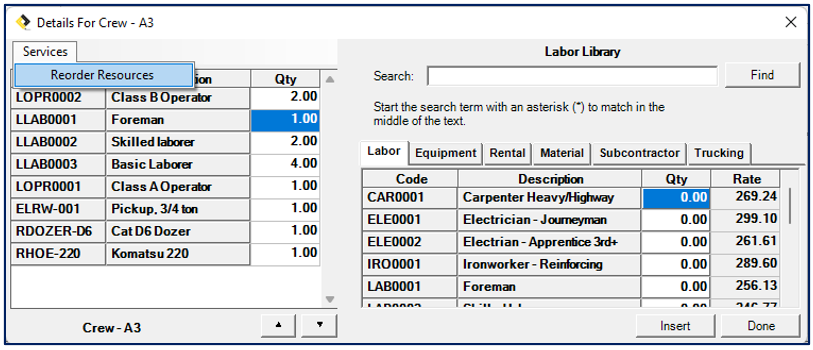
Build the Crew Once. Adjust It for Every Job.
Accurate crew costing connects four essential pieces of the estimate: labor, equipment, time, and production. The hourly crew rate shows what the combined resources cost. The production rate converts that hourly cost into a cost per installed unit.
Building those relationships correctly is more important than simply producing the lowest number. A reliable estimate reflects the crew that will perform the work and the conditions that will affect its production.
Estimators should not have to recreate commonly used crews every time they begin an estimate. Build the crew once, save it as a starting point, and adjust it whenever the job requires it.