
The difference between winning profitable work and losing money on a project often comes down to estimate accuracy. For heavy civil contractors, even small estimating errors can affect labor costs, equipment usage, material pricing, and overall profitability. Here are five key factors estimators should focus on when building more reliable bids.
#1: Historical Cost Data
Historical cost data helps estimating teams replace assumptions with real project experience.
Instead of guessing labor requirements, production rates, or unit costs, estimators can review information from previous jobs to validate their numbers. This often leads to more accurate bids and greater confidence during the estimating process.
For example, if a construction firm completed a similar sitework project last year, historical job data can provide valuable insight into crew productivity, equipment usage, and actual project costs. That information can help identify missed costs and improve future estimates.
Research on construction cost estimation performance has found that the quality of available project data plays a significant role in estimate accuracy. Companies who maintain a construction estimating database are often better equipped to build consistent estimates, reduce uncertainty, and avoid costly surprises during the bidding process.
#2: Production Rates
Production rates are one of the biggest factors affecting construction bid accuracy.
Production rates measure how much work a crew or piece of equipment can complete within a given period. If those assumptions are too optimistic, labor and equipment costs can quickly exceed the estimate. If they're too conservative, an estimator may submit a bid that isn't competitive.
Many estimating errors occur because estimating teams rely on industry averages rather than their own historical performance. Tracking production rates from completed projects provides a more realistic picture of how work is actually performed in the field.
By using historical production rates, construction firms can build estimates based on real-world productivity instead of guesswork, leading to more accurate bids and better decision-making.
Learn more in our guide to Production Rates in Construction Estimating.
#3: Labor Cost Assumptions
Even a well-organized estimate can become inaccurate if labor costs are underestimated.
Labor is often one of the largest expenses on a construction project, and small errors can have a significant impact on profitability. Wage rates, crew composition, overtime, travel time, and labor burden all influence the true cost of completing the work.
Estimators who fail to account for these factors may submit bids that appear competitive but leave little room for profit once the project begins.
Using a consistent estimating process helps ensure labor assumptions are applied uniformly across projects. Standardized estimates also make it easier to compare bids, review costs, and identify areas for improvement.
See how sitework estimating software can help contractors build more accurate bids.
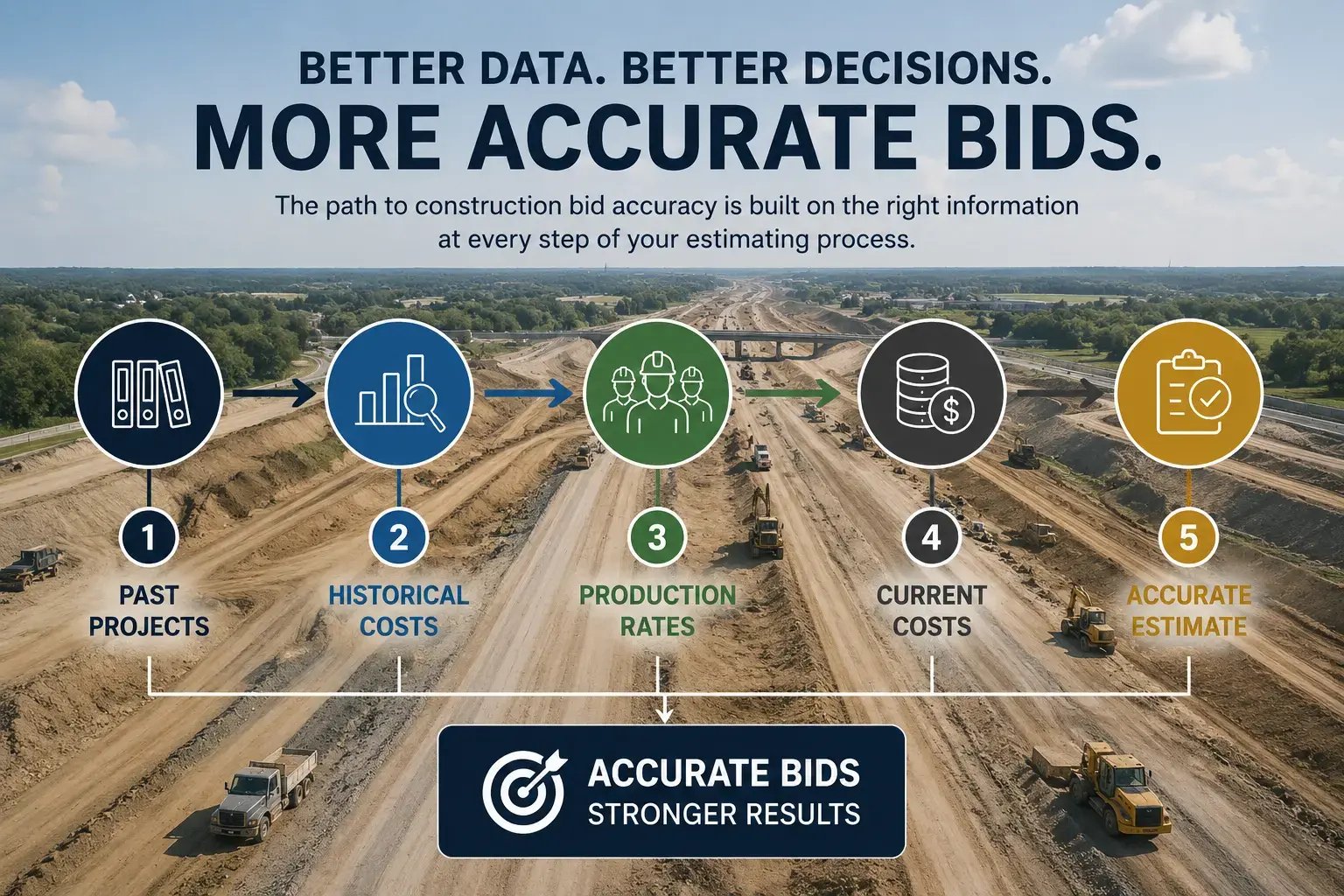
#4: Current Material and Equipment Costs
Accurate construction estimates depend on current pricing. Material costs, fuel prices, rental rates, and supplier pricing can change quickly. An estimate based on outdated information may no longer reflect the actual cost of completing the work. An estimate based on outdated information may no longer reflect the actual cost of completing the work.
Regularly reviewing vendor pricing and updating cost information helps estimators avoid unpleasant surprises during the bidding process. It also improves confidence that unit prices accurately reflect current market conditions.
According to Texas A&M's construction estimating best practices, maintaining reliable cost information is an important part of developing accurate estimates and reducing uncertainty during project planning. The most successful estimating teams treat cost data as a living resource that must be reviewed and updated regularly.
#5: Consistent Estimating Processes
Accurate bids are rarely the result of luck. They are usually the result of a repeatable estimating process.
When estimates are organized consistently, contractors are less likely to overlook costs, duplicate items, or make assumptions that vary from project to project. Standardized cost codes, estimate reviews, and documented procedures all contribute to greater bid accuracy.
A consistent process also makes it easier to train new estimators and maintain estimating quality as a company grows.
Many heavy civil construction companies use construction estimating software like Estimating Link® to help organize historical cost data, production rates, cost codes, and estimate information in a single location. This improves visibility and helps create more consistent estimates across projects.
Learn more about the power of cost codes in heavy construction.
Better Construction Cost Estimating Starts With Better Information
Improving construction bid accuracy isn't about finding a shortcut. It's about making better decisions with better information.
Historical cost data, production rates, labor assumptions, current pricing, and consistent estimating processes all play an important role in building reliable estimates. When these factors work together, contractors can bid with greater confidence and reduce the risk of costly surprises.
The goal isn't simply to win more work—it's to win profitable work.
Estimating Link® helps heavy civil contractors organize cost data, production rates, cost codes, bid items, and estimate history in one system. If your team is looking for a better way to build consistent, accurate estimates, explore Estimating Link® or schedule a demo.